How I build.
Three products, taken apart in the order they were made. Every step below comes from the project’s own records.
As of November 2026
00In this page
Three builds, one method.
Each chapter: the film, five steps in the order they happened, the toolkit, and one rule the work kept.
01Chapter
Rally
Start here if you care how AI and human review share one product.
Helping new hires become capable contributors, faster.
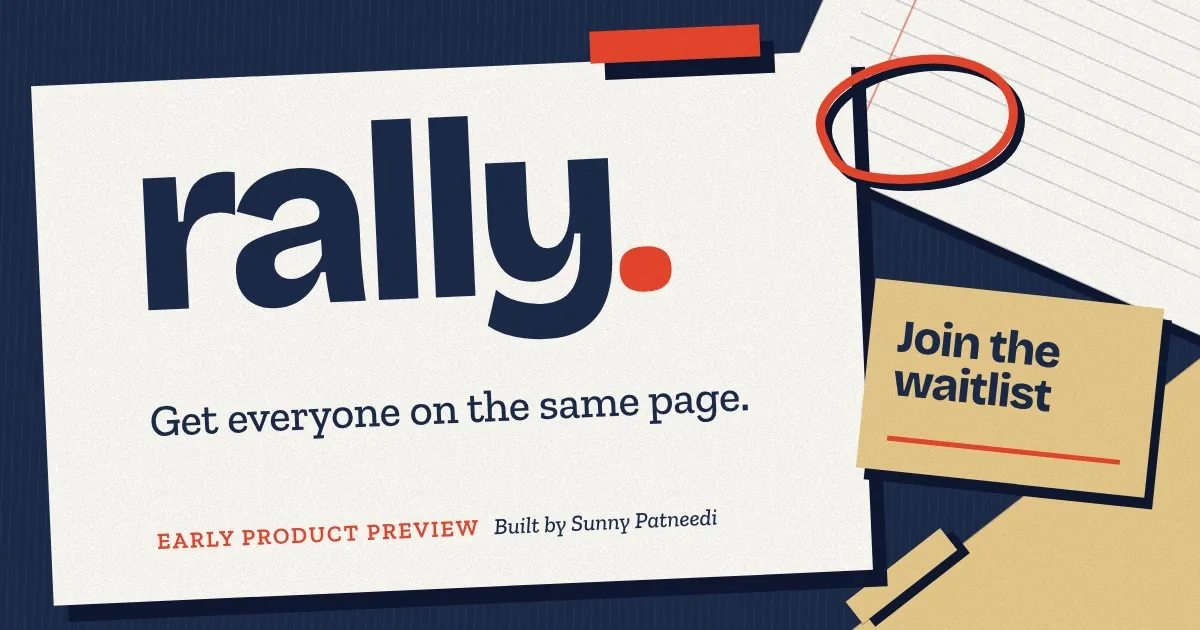
Read the transcript
An overhead view of scattered office paper and folders squaring up into one neat stack on a navy desk. Three cards marked A, B and C appear beside a short scenario, a sample source sheet slides over the middle card, and an orange note names the outcome. It ends on a paper end card with the Rally wordmark.
On-screen text: Early product preview. Get everyone on the same page. Make your call. Decision lab · synthetic demo. A customer asks for a feature by Friday. What do you promise? A, B, C. Check the sample source: Customer commitments · v3. Fictional policy. Authored demo content, not AI output. One decision. A clearer next step. Rally. Get everyone on the same page. Early product preview. Built by Sunny Patneedi. Join the waitlist.
How it was built.
01 · Discover
Write the product contract first.
A filled brief names the learner, the buyer hypothesis and the first useful result: one realistic company decision, explained with its source. It also names what Rally must never do, such as scoring, ranking or hiring decisions.
Record Product and design contract
02 · Make
AI drafts. People publish.
The workspace turns reviewed company sources into role-specific lessons and practice. AI drafts carry their sources; a person approves before any learner sees them, and Drive imports re-check each reader’s own permissions.
Record Rally README · learning workspace
03 · Verify
Test the real path, not the mock.
51 browser tests drive real browser → Express → PostgreSQL journeys, including revocation, cancellation and retry, on top of 65 foundation tests and 106 application tests.
Record Verification record, Nov 7, 2026
04 · Correct
Let review change the design.
Independent review found AI coaching text that was too open-ended. Now the model picks from a small set of allowed suggestions and the server supplies the words. Model-written conclusions and scores are rejected.
Record Verification record · review corrections
05 · Gate
Name what isn’t proven.
Rally is a release candidate, not a verified launch. Live provider and hosted acceptance are still open, and the record says plainly that local fixtures don’t prove production works.
Record Rally README · release status
The toolkit.
- Interface
- ReactViteTailwind
- Server
- Express 5PostgreSQL
- Identity
- Clerk
- AI
- OpenAI via the AI SDKProvider storage off
- Sources
- Google Drive, per-reader permission checks
- Checks
- VitestPlaywrightDisposable PostgreSQL
Synthetic tests can prove boundaries, not learner value
02Chapter
Cue
Start here if you’re building agents people can actually stop.
Hand work to any AI model and know what it actually did.

Read the transcript
A gouache poster: a storm of orange scribbles is swept off the page by one calm black brush line. A sage-green kettle sits on the line and begins to steam, and a small orange bell rings beside a “Needs approval” tag. It ends on a sage end card with the Cue wordmark.
On-screen text: A two-minute wait gets a two-minute task. Needs approval. Private preview · simulated. Cue. The agent that knows when to be quiet. Private preview. Join the waitlist · cue.sunnypatneedi.com. Built by Sunny Patneedi.
The agent system behind it
I build and run my own agent system with shared memory, recorded runs, approval gates and automated review. I’m designing Cue as an open standard for agent execution reliability.
- Multi-agent team
- Specialized agents that delegate to each other, use tools and review each other’s work, with approval gates before anything ships.
- Agent memory
- Memory the agents share, every run recorded in Trail, and the Cue Core format that describes it.
- Self-improving loops
- Drafts scored daily by Reply Editor, polish and review rounds, and mutation testing on pull requests.
- Platform direction
- Cue and OSFP as one shared status standard for agent work. It’s my Apple Maps Transit lesson applied to agents.
- Research to prototype
- Local compute first, sandboxed runs, and small in-browser studies of new model ideas.
Where it stands. Every change lands only after I approve it. Nothing is tuned against measured results yet, memory has no benchmark, and no one else uses it yet.
How it was built.
01 · Discover
Name things so they can’t blur.
Cue’s vocabulary keeps an intent apart from a permission, an attempt apart from a retry, and verification evidence apart from what a model says about its own work.
Record Domain language
02 · Decide
Write every decision down.
Twelve decision records so far: one local execution authority, durable stop and containment, an independent progress deadline. After an uncertain start there is no automatic fallback to another harness or cloud model.
Record Decision records 0001–0012
03 · Make
Native, local, encrypted.
Cue stands for Common User Environment: one set of permissions and evidence whichever model does the work. SwiftUI apps for Mac and iPhone share one kit. The Mac runs one approved coding task through local Codex or connected Claude Code; the phone captures and reviews it over an encrypted phone-to-Mac link.
Record Cue for iPhone and Mac
04 · Verify
Evidence is the tested tree, not the summary.
Cue’s check binds the tested code to a frozen review copy, its test count and its exit status. Passing, not run, failed and incomplete stay four different answers.
Record Domain language · verification evidence
05 · Report
Publish the miss.
On September 20 the regression suite passed: 802 tests, 65 skipped. Acceptance on real history did not: zero validated drafts, and 9 of 18 expected claims on the held-out set, with no unsupported ones. So it isn’t called a verified release.
Record Delegation inference results, Sep 20, 2026
The toolkit.
- Apps
- SwiftUImacOS 15iOS 18
- Harnesses
- Local CodexConnected Claude Code
- On device
- Optional Apple modelNo hosted fallback
- Security
- AES-GCM vaultSecure Enclave–wrapped keys
- Checks
- Separate verification containersDevelopment and held-out sets
- Tooling
- XcodeXcodeGenTypeScript
Model prose is not evidence
03Chapter
SayMake
Start here if you need AI that is safe for kids by construction.
Helping young people become creators, not just consumers.
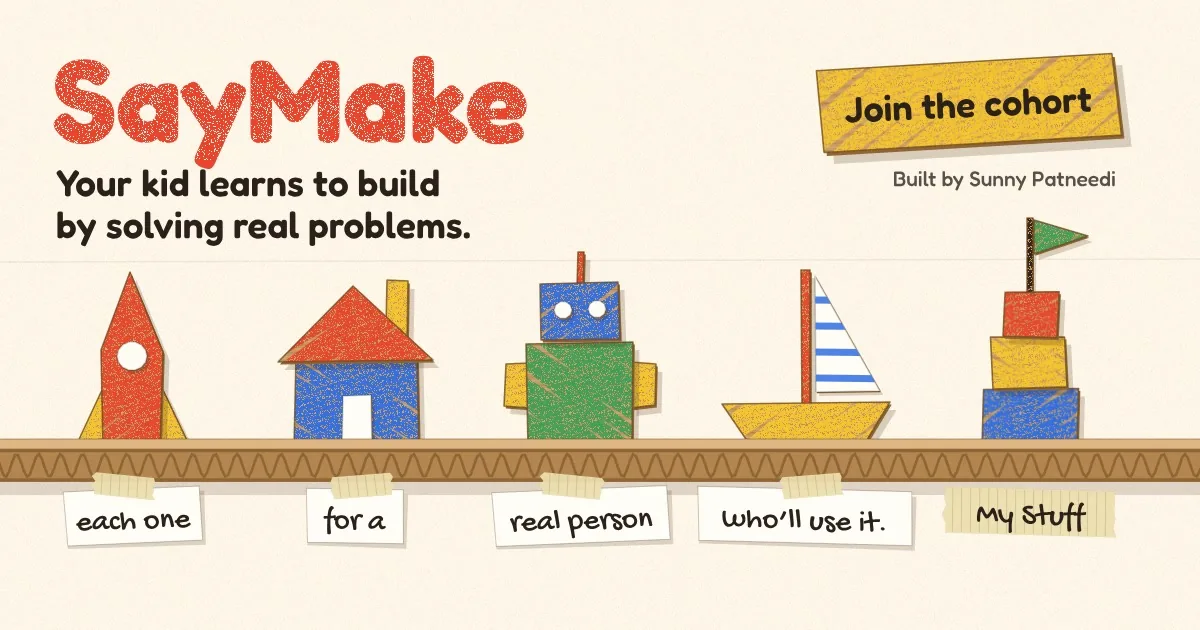
Read the transcript
Stop-motion cardboard and wax crayon. Large cut-out letters spelling MAKE stand on a shelf and turn, one by one, into a rocket, a house, a robot and a sailboat, each with a paper label. A grey “done for you” note sits beside a handwritten coach note that asks a question instead, and a block tower stacks up at the end of the shelf. It ends on the SayMake end card.
On-screen text: Say MAKE. Each one for a real person who’ll use it. My Stuff. Done for you: “Here is the app I’ve built for you.” SayMake · Build Coach: Nice! What habit do you want to track first? Asks first. The kid does the thinking. SayMake. Your kid learns to build by solving real problems. Join the cohort. Built by Sunny Patneedi.
How it was built.
01 · Decide
One voice rule: the kid builds.
SayMake suggests the next step and never does the build for the child. Copy that says “I’ll build it for you” or orders a child around fails the trust check.
Record Guardrail evals · trust suite
02 · Make
A design system that can’t drift.
Brand tokens and components are the source of truth. Swatches and screenshots regenerate from them, and the build fails if the reference goes stale.
Record SayMake design system
03 · Verify
Guardrails block the deploy.
An eval harness checks kid safety, privacy, security, prompt injection, voice and learning-science rubrics in about two seconds. Its gates run from 85% for prompt injection to 100% for privacy and security, and a failure blocks the deploy.
Record Guardrails eval harness
04 · Verify
Attack it with public corpora.
Prompt-injection probes include public jailbreak and harm benchmarks, run through SPEAR, the open-source LLM security middleware I maintain.
Record Prompt-injection and SPEAR corpora suites
05 · Verify
A rubric, then a judge.
Real model output is graded twice: by a deterministic kid-copy rubric, and by an LLM judge for coach voice, kid safety, reading level and honesty.
Record Coach content suite (live)
The toolkit.
- Interface
- ReactLexend + Inter design system
- Server
- Express 5PostgreSQLDrizzle
- AI
- OpenAIDeterministic mock in tests
- Safety
- SPEARPII redactionRate limits
- Media
- Remotion
- Checks
- VitestSupertestPlaywrightGuardrail evals
Asks first. The kid does the thinking
04The method
Discover. Make. Verify.
I enjoy the full journey, especially when the problem isn’t well defined and the product doesn’t exist yet.
Discover what matters
Understand people, their problems, and what’s newly possible with emerging technology.
In practice: Rally’s product contractMake it real
Move from ambiguity to a useful prototype. Build, test with people, and refine the experience.
In practice: Cue’s native appsVerify the outcome
Evaluate behavior, find failure modes, and build appropriate oversight into dependable systems.
In practice: SayMake’s guardrail evals
05What next?
Let’s build something important.
If you’re building something where the technology is promising but the right product is still being discovered, I’d love to talk.
Every step on this page comes from the project’s own records, as of November 2026. The repositories are private, so records are named rather than linked.